

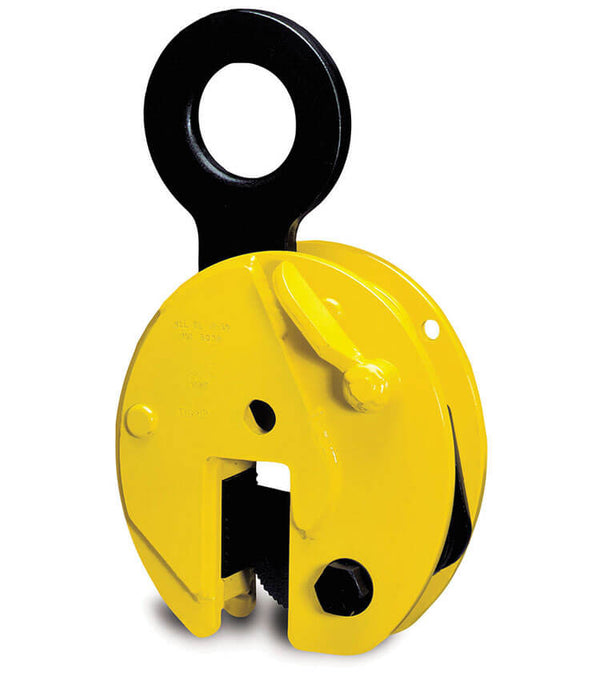


Camlok Vertical Plate Clamps CZ 100-30000kg with Safety Lock

Incl. VAT. Shipping calculated at checkout.
- Heavy-duty vertical plate clamp. Working load limit from 1000 kg up to 30000 kg per clamp.
- Safety lock. Spring-loads the cam jaw so the clamp cannot open even when there is no load on the jaw.
- Lifts and rotates through 180 degrees. Moves plates between horizontal and vertical positions.
- Jaw capacity up to 130 mm. For plate surfaces with a hardness below HRC 30/Brinell 300.
- Hook ring or link fitting. Supplied with hook ring as standard, link fitting as an option.
Accepted payment methods


shipping
Camlok CZ Vertical Plate Clamps
Lifting Clamps are one of the most important pieces of equipment in many lifting and material handling operations. No matter if it is in the manufacturing or construction process, lifting clamps serve a critical function such as lifting and moving a flat plate, rolled stock and beams.
These heavy-duty vertical plate clamps with a working load limit up to 30000 kg are primarily used for transporting sheet metal and steel plates in the vertical position, as well as lifting and rotating through 180 degrees.
They can also be used for transporting steel constructions and profiles. It is recommended to use a pair of plate clamps in conjunction with a spreader beam for a long plate.
Functions:
- The jaw is opened and closed with the locking lever.
- The safety lock spring loads the cam jaw, preventing the clamp from opening even when there is no load on the jaw.
Uses:
- For lifting long plates (2 clamps and a lifting beam must be used)
- For lifting short plates (a single clamp can be used)
- For lifting plates from the horizontal to the vertical position and vice versa through 180 degrees
Units are supplied as standard with a hook ring; the link fitting is available as an option (CZ 30/30L is supplied with the link as standard). Clamp repairs must be done by a trained person.
Specifications:
- Capacity (WLL, per clamp): 100 kg - 30000 kg (minimum to maximum load, depending on model)
- Jaw Capacity: 0 - 130 mm (depending on model)
- Weight: 4 kg - 295 kg (per clamp with hook ring)
- Hardness level of the plate surface: below HRC 30/Brinell 300
- Designed & Made in the UK
| Model (shop reference) | WLL (min. - max. load) | Jaw Capacity (standard / L) | Weight (standard / L) |
|---|---|---|---|
| CZ 1 (cz-100) | 100 - 1000 kg | 0 - 20 mm | 4 kg |
| CZ 2 (cz-200) | 200 - 2000 kg | 0 - 32 mm | 9 kg |
| CZ 3 (cz-300) | 300 - 3000 kg | 0 - 32 mm | 10 kg |
| CZ 4 / CZ 4L (cz-400) | 400 - 4000 kg | 0 - 32 / 30 - 60 mm | 10 / 12 kg |
| CZ 6 / CZ 6L (cz-600) | 600 - 6000 kg | 0 - 50 / 50 - 100 mm | 21 / 28 kg |
| CZ 8 / CZ 8L (cz-800) | 800 - 8000 kg | 0 - 50 / 50 - 100 mm | 26 / 32 kg |
| CZ 10 / CZ 10L (cz-1000) | 1000 - 10000 kg | 0 - 50 / 50 - 100 mm | 30 / 37 kg |
| CZ 15 / CZ 15L (cz-1500) | 1500 - 15000 kg | 0 - 50 / 50 - 100 mm | 75 / 88 kg |
| CZ 20 / CZ 20L (cz-2000) | 2000 - 20000 kg | 0 - 65 / 65 - 130 mm | 123 / 136 kg |
| CZ 30 / CZ 30L (cz-3000) | 3000 - 30000 kg | 0 - 65 / 65 - 130 mm | 195 / 295 kg |
How to use Vertical Plate Clamps safely?
Before Lifting
-
Inspect the plate and clamp
- Based on operating manual -
Position the clamp:
- Place the clamp over the load centre of the plate. If the plate is long, use two clamps in conjunction with a spreader beam.
- Care must be taken to ensure no one clamp takes more than its SWL.
- Put the clamp onto the plate as far as it will go
- Place the fixed jaw onto the plate and turn the lever to the 'LOCK' position
- Check correct fitting and position before lifting
After Lifting (Release the plate & clamp)
-
Place down the load gently
- Do not lower quickly onto the floor -
Ensure the lifting sling is sufficiently slack
- In order to allow the hook-ring to be pushed down into the shell. -
Push the hook-ring down into the clamp body
- While turning the locking lever - Release the lifting clamp
Applications of Vertical Plate Clamps:
- Wind Power Energy
- Offshore
- Ship & Yacht Construction
- Tank & Vessel Construction
- Construction
Others:
- Please refer to the diagram for the Camlok product specifications and read the operating manual carefully before use
- Safety webinar by CM: